Pain Points Experienced by Lab Users When Setting Up a Lab
By Arena Consultants · August 20, 2025 · 4 min read
If you work in a lab, your days are already full. You are juggling experiments, training new team members and keeping day-to-day operations running smoothly.
Then a new lab project begins, and suddenly you are also being asked to help identify a new premises, list every requirement, share your workflows in detail and keep up with an ongoing loop of meetings, emails and reviews.
It is demanding. And we understand that completely.
The pain points of setting up a lab
When a new lab is planned, lab users usually face the same set of challenges:
| Pain point | Why it is hard | What makes it easier |
|---|---|---|
| Finding a new premises | Lab users are asked to judge sites and buildings, often without knowing what a lab needs from a building | A designer assessing site and building suitability with you |
| Listing every requirement | It is hard to remember everything, and some needs only become clear later | Structured questionnaires and permission to say "not sure yet" |
| Explaining workflows | Daily routines are so familiar they are hard to put into words | Showing rather than telling: site visits and walk-throughs |
| Managing communication | Meetings, emails and reviews pile up on top of a full workload | Focused workshops and one clear point of contact |
| Fear of missing something | Decisions made now will shape the lab for years | Layouts and 3D views that make gaps easy to spot early |
Why we ask so many questions
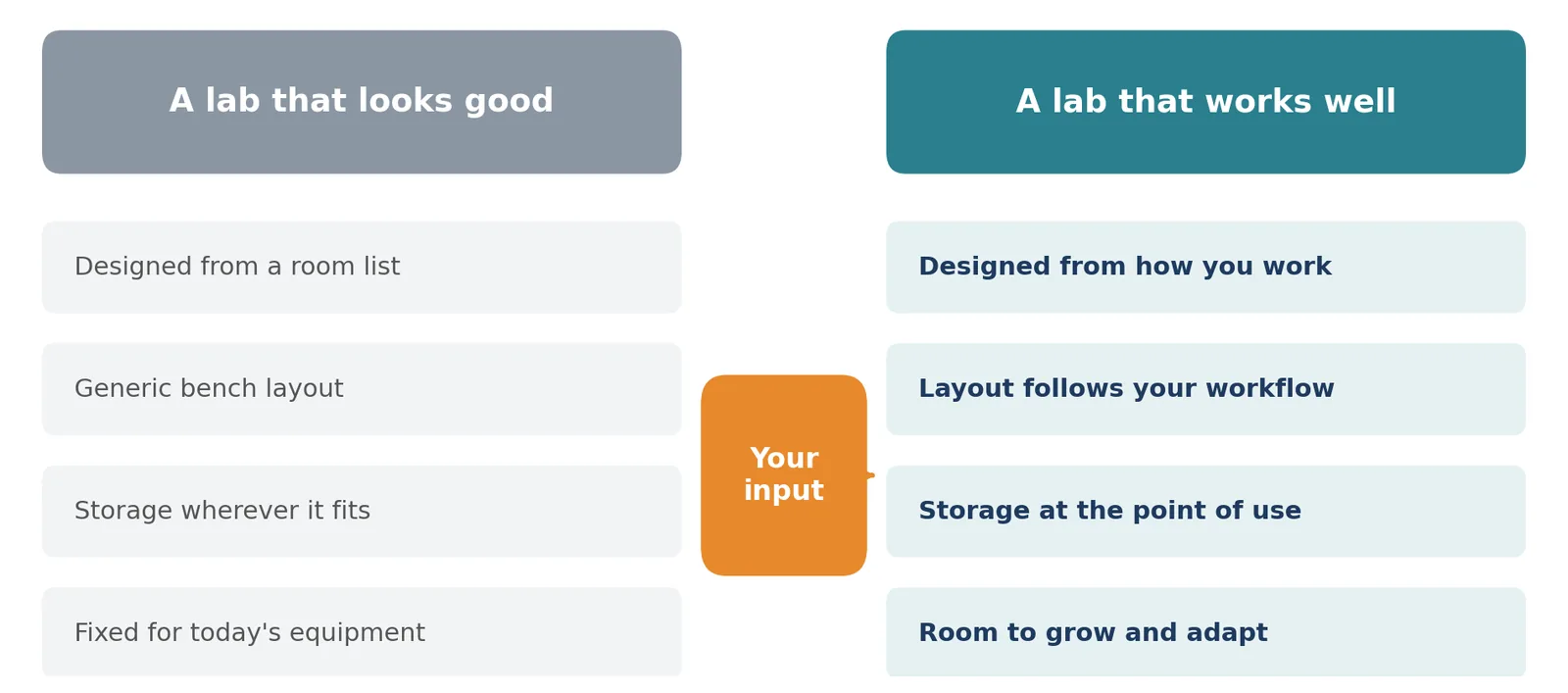
Here is the thing: your input is what makes the difference between a lab that looks good and a lab that works well.
A designer can create an attractive, compliant lab from a list of rooms and a floor area. But only the people who work in it every day know how samples really move, which equipment is always in demand, where people get in each other's way and what slows the work down. Without that knowledge, even a beautiful lab can be frustrating to work in.
Those long meetings, questionnaires and checklists have one purpose: to understand your reality so we can design around it.
Sound familiar?
- You have been asked to fill in a requirements sheet with no idea where to start.
- The same questions seem to come up in every meeting.
- You are worried that if you miss something now, you will be stuck with it for years.
All of this is normal, and there are ways to make it easier.
Three ways to make the process easier
If you are a lab user stepping into the planning process, these three ideas can take a lot of the pressure off.
1. Do not worry about having all the answers
Nobody expects you to arrive with a complete specification. Some answers only emerge as the design develops, and that is fine. It is far better to say "we are not sure yet" than to guess, because a good designer will help you work through the uncertainty and plan flexibility where the answer is still open.
2. Share how you work, not just what you need
A list of equipment and room sizes tells a designer what to fit in. A description of how you actually work tells them how to arrange it. Walk them through a typical day, show them a process from start to finish or let them watch your team at work. The story behind your requirements is often more useful than the requirements themselves.
3. Speak up about what slows you down
Your daily frustrations are some of the most valuable information a designer can get. The queue at the same instrument, the long walk to storage, the cramped corner where people bump into each other: each one points directly to something the new lab can fix. Small complaints often lead to the biggest improvements.
Try this: Keep a note on your phone for a week. Every time something in the lab slows you down or frustrates you, add a line. Share the list at your next design meeting. It takes seconds a day and gives your designer exactly what they need.
How we make it easier on our side
Collaboration works both ways. Our job is to make the process lighter for you, not heavier. That means:
- Structured questionnaires and templates, so you are not starting from a blank page.
- Focused workshops with clear agendas, rather than open-ended meetings.
- Visiting your current lab to see how you work first-hand, instead of asking you to describe everything.
- One clear point of contact, so communication does not become an endless loop.
- Layouts and 3D views that make it easy to react and give feedback, without reading technical drawings.
Ask this: What is the minimum we need from each person on our team, and how can we make it easy for them to give it?
Efficient labs begin with good collaboration
An efficient lab design begins with seamless collaboration between the designer and the client's team. Your time and input are an investment in a space you will work in for years.
And remember: we are here to make the process easier, not harder.