
Understanding Lab Needs from the Users' Perspective
By Arena Consultants · December 17, 2024 · 5 min read
Standards, codes and guidelines tell us how to make a laboratory safe and compliant. They are essential, and no good lab is designed without them. But they cannot tell us how a particular team works, where they lose time, or what would make their day easier.
Over the years, we have found that truly understanding a lab's requirements starts with understanding the scientists, researchers and technicians who will use it every day. Their stories, frustrations and hopes teach us what no guideline ever can.
Designing from the user's perspective leads to smarter, more human-centred spaces. But it only works when lab users share their insights openly. This post looks at why user input matters so much, and how lab users can help their designers get it right.
Why guidelines alone are not enough
Two labs can follow the same standards, use the same equipment and cover the same area, yet work completely differently. One team might run short, high-volume tests; another long, delicate experiments. One might work alone at the bench; another in tight collaboration. Those differences change almost everything about how the space should be laid out.
The people who know these details best are not always the ones writing the project brief. Leadership sets the vision. Facility teams manage the project. But the bench scientists and technicians are the ones who will live with every design decision, every working day, for years.
Sound familiar?
- The new lab looked great at handover, but within a month people were rearranging it.
- Researchers keep their most-used items on the bench because storage is too far away.
- Nobody asked the technicians before the layout was finalised.
These are signs that a lab was designed for its users, not with them.
What lab users tell us that no guideline can
Some of the most valuable design insights come from conversations with the people at the bench. A few typical examples:
| What a lab user says | What it tells the designer | How the design responds |
|---|---|---|
| "We always queue for the same balance." | A piece of equipment is a bottleneck | Place it centrally, add space for a second unit, or give it a dedicated zone |
| "I walk to the other end of the lab for every sample." | Related steps are too far apart | Rearrange adjacencies so the workflow follows a short, direct route |
| "We keep reagents on the bench because the store is too far." | Storage is in the wrong place | Bring point-of-use storage closer to where work happens |
| "The write-up desks are in the noisy corridor." | Focus work is being disrupted | Create quieter write-up areas close to, but separate from, the lab |
| "We are getting a new instrument next year." | Future needs are not yet in the brief | Plan space, power, data and services for it now |
None of these would appear in a standards document. All of them make a real difference to how well the lab works.
How lab users can help design better spaces
Collaboration works best when users actively share what they know. If you work in a lab that is being designed or upgraded, here is how you can help:
1. Share real examples of bottlenecks
General comments like "the lab is too small" are hard to design from. Specific stories are gold. Tell your designer where you wait, where you walk too far, where people bump into each other and which tasks always take longer than they should. Real examples point directly to real solutions.
2. Highlight your small daily habits
The little things matter more than people expect. Where do you put your notebook? Which items do you reach for a hundred times a day? Do you prefer to sit or stand for certain tasks? Small habits like these shape bench heights, storage positions and the placement of sinks, outlets and equipment.
3. Speak up about your future needs
A lab is built for years, not months. Share the methods you expect to adopt, the equipment you hope to get and how you think your team will grow. It is far easier to plan for change now than to retrofit for it later.
Try this: For one week, keep a short note every time something in your lab slows you down, frustrates you or makes you think "this could be better." Share the list with your design team. It will be one of the most useful documents in the project.

How we involve users throughout a project
At Arena Consultants, user input is not a one-off survey at the start. It runs through the whole project:
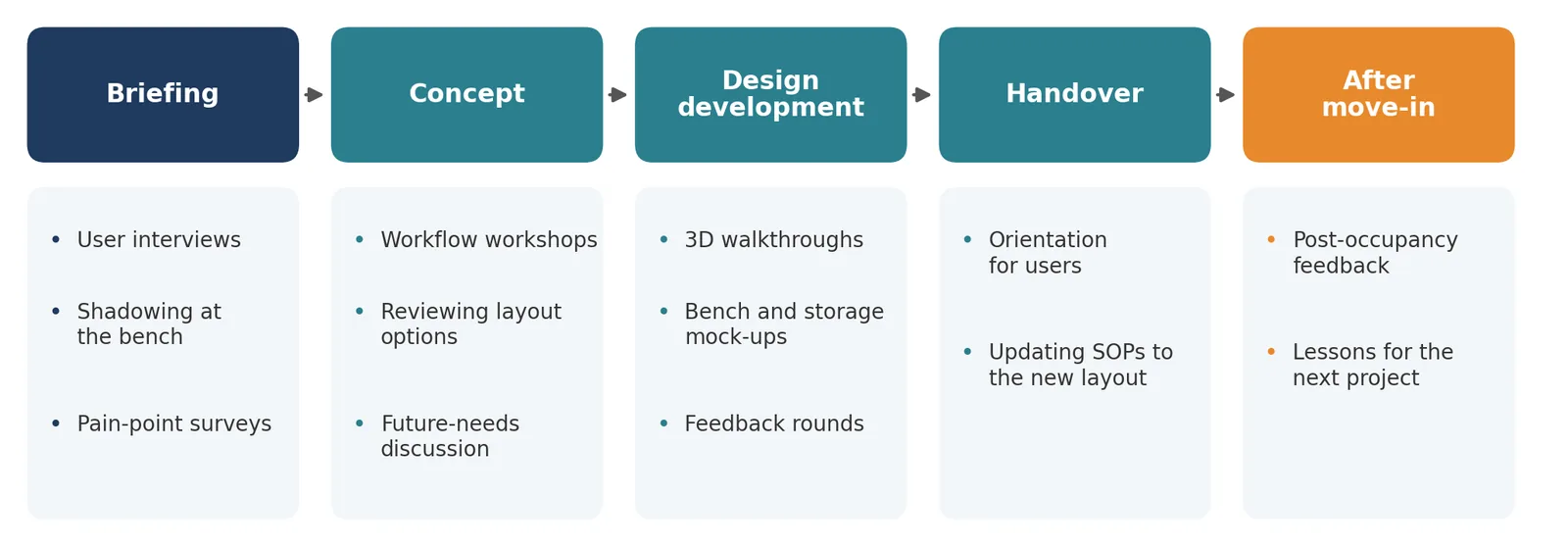
Seeing a lab in 3D, or standing at a mock-up of a bench, often prompts insights that never came up in a meeting. And feedback after move-in helps us learn what worked, so the next lab is even better.
Ask this: Have the people who will work in this lab every day seen the layout yet? If not, who is speaking for them?
What user-centred design delivers
When labs are designed in close collaboration with their users, the results go well beyond comfort:
- Smoother workflows, because the layout follows how people actually work.
- More inclusive spaces, that work for people of different heights, abilities and working styles.
- Greater flexibility, because future needs are planned in from the start.
- Stronger ownership, because people who helped shape a space are more likely to use it well and look after it.
Most of all, a lab designed around its users becomes a place that supports people to do their best work, and to make the breakthroughs that matter.
Design with users, not just for them
Guidelines make a lab safe. Users make it work. The labs that inspire people are the ones shaped by the people inside them: their routines, their frustrations and their ambitions.