
How Many Design Revisions Are Too Many?
By Arena Consultants · June 17, 2025 · 4 min read
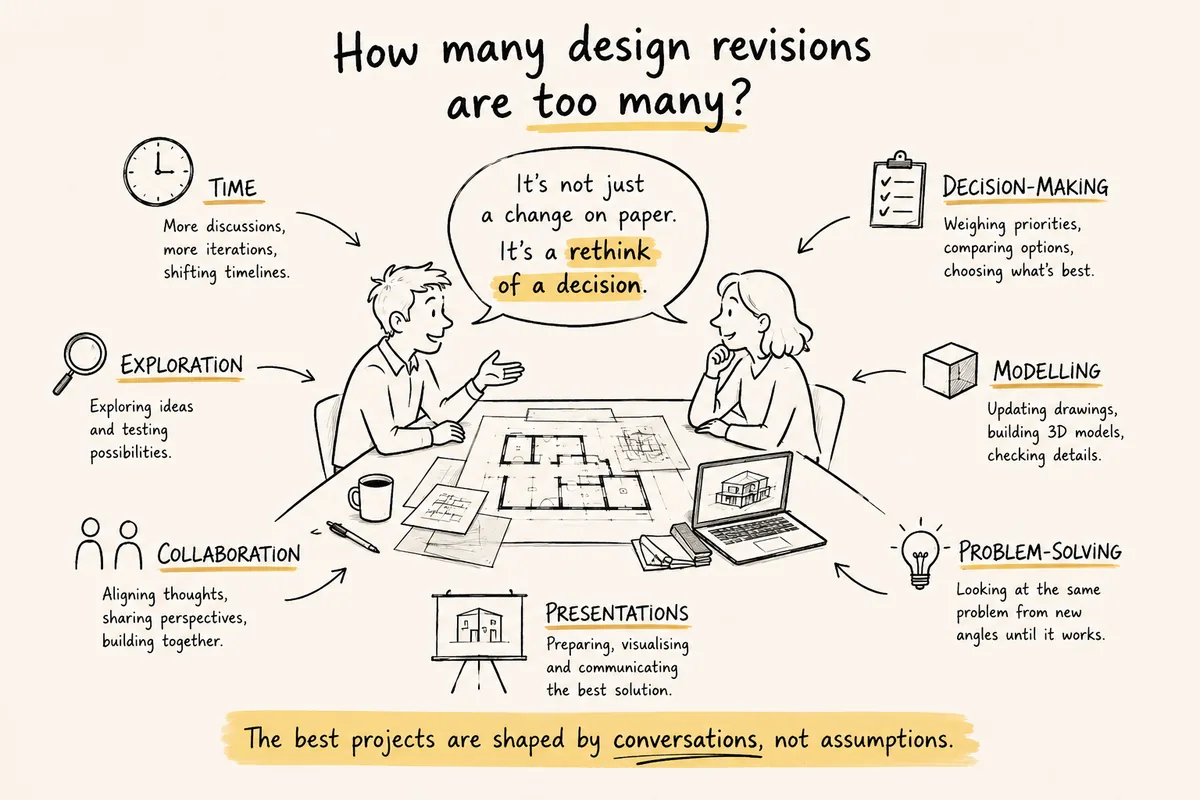
How many design revisions are too many? There is no single number. Some projects need many rounds of refinement; others need very few. What matters far more is when a revision happens, why it is needed and who it affects.
Let us paint a picture.
A conversation about revisions
Client: Can you offer multiple design revisions?
Architect: Sure. But it depends on the project stage, the extent of the changes and how they affect everyone involved.
The client looks puzzled. To them, a revision has always seemed like a simple change on paper.
Architect: At the concept stage, revisions are relatively easy. Usually only the design team is involved, and ideas can still evolve without major consequences.
Architect: But as the project progresses, decisions become interconnected. Once equipment layouts are frozen, building services are coordinated or qualification planning is underway, even a small change can trigger revisions across several teams. That is when the impact on timelines, effort and cost becomes much greater.
The client nods thoughtfully.
Architect: Many revisions are not really about the design. They happen because key stakeholders were not involved early enough in the decisions. And sometimes, it helps to trust a designer whose proposal has come out of many evaluations and careful consideration.
Client: So revisions are not just about changing a drawing?
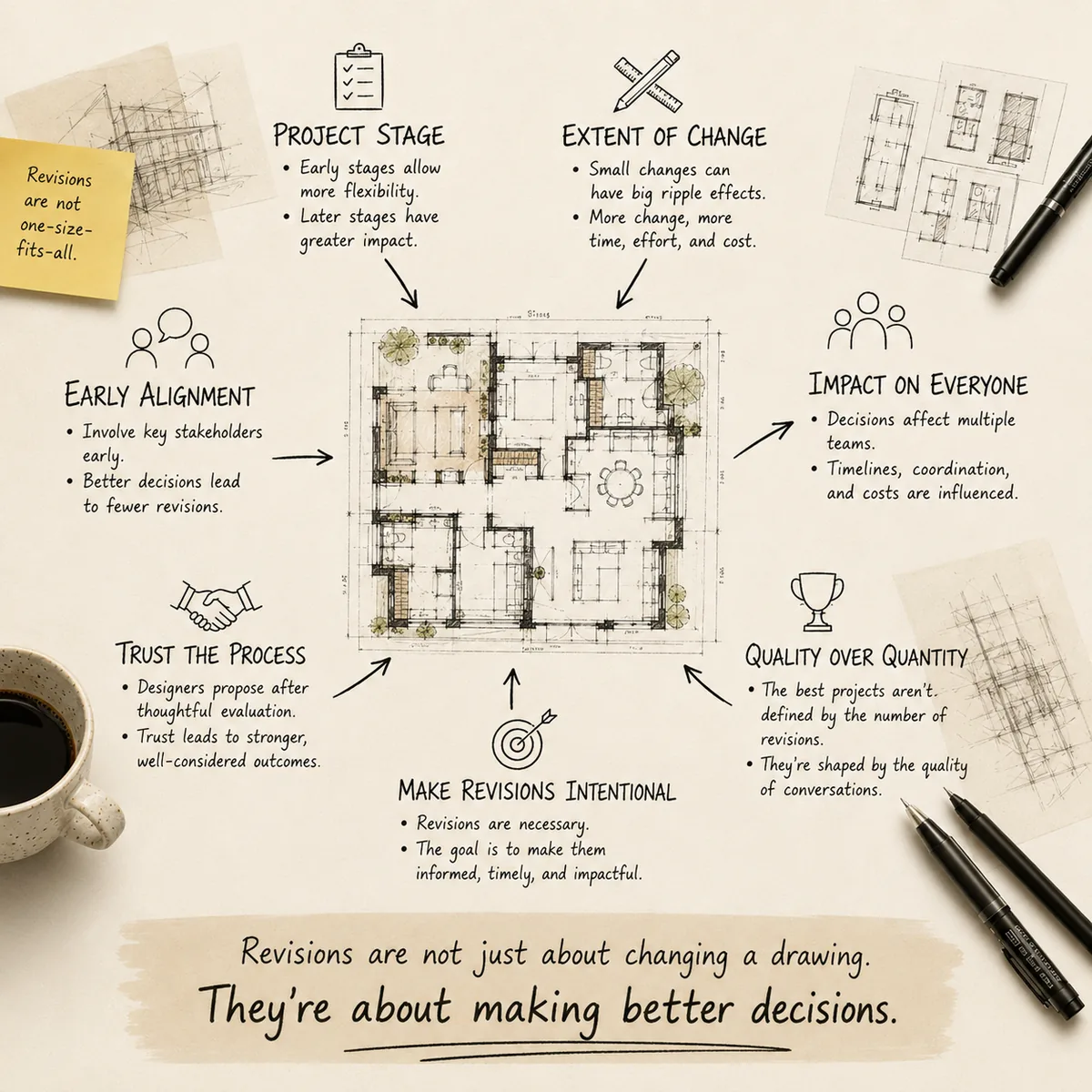
Architect: Not at all. Revisions are often necessary. The goal is not to avoid them, but to make them intentional, informed and timely.
Why the same change costs more later
In a lab project, design decisions build on one another. A bench position determines where services run. Services determine ductwork and ceiling space. In regulated labs, such as pharmaceutical quality control labs, the design also feeds into qualification planning, the formal process of documenting and verifying that facilities and equipment are fit for purpose. Change one early decision late in the project, and everything built on top of it may need to change too.
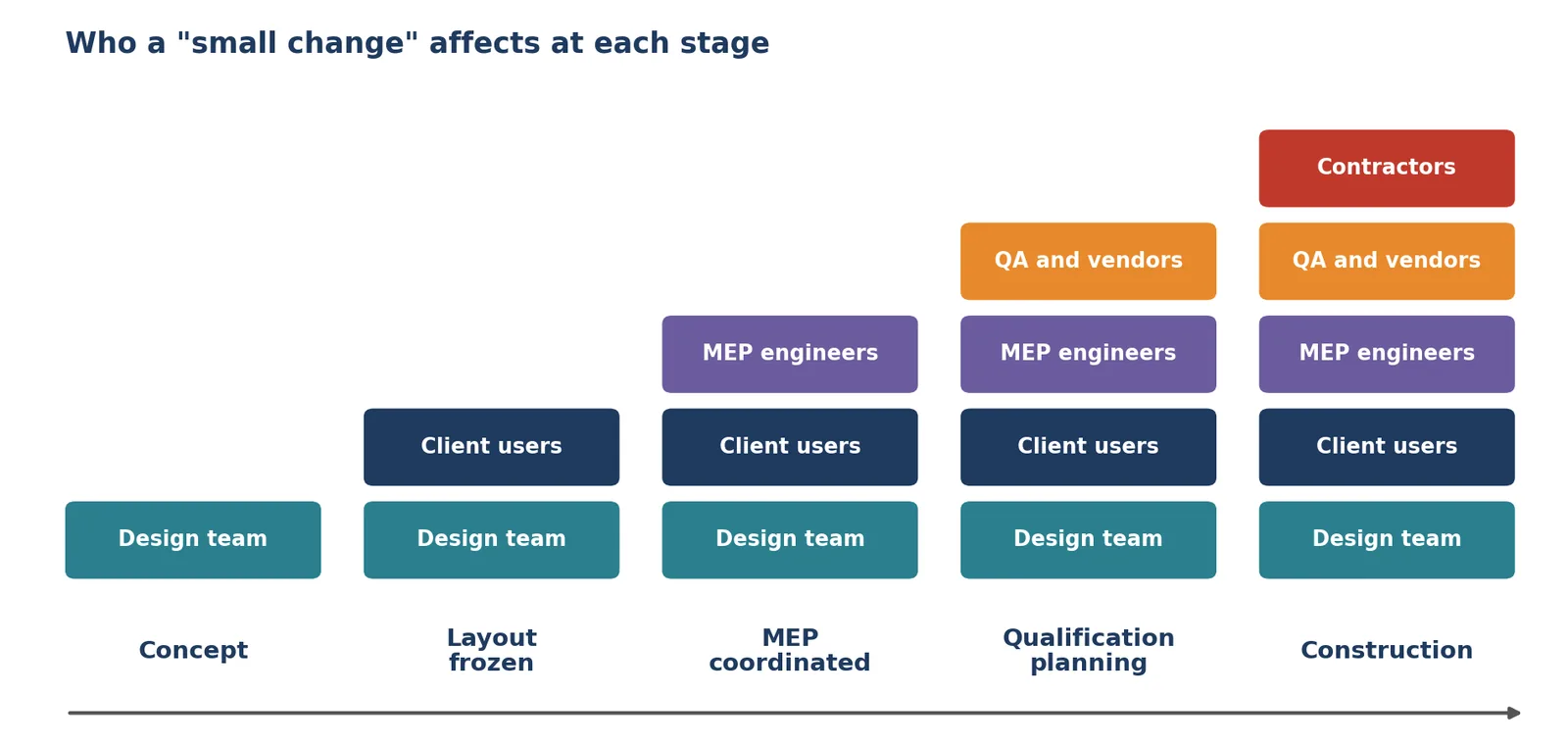
| Project stage | What a change involves | Relative impact |
|---|---|---|
| Concept | Redrawing ideas within the design team | Low: ideas are still evolving |
| Layout frozen | Rechecking adjacencies, equipment positions and user sign-offs | Moderate |
| Services coordinated | Re-routing ducts, pipes, cables and drainage across several disciplines | High |
| Qualification planning | Revising documentation and re-verifying with quality teams and vendors | High |
| Construction | Rework on site, new materials and delays | Very high |
Sound familiar?
- A "quick change" to one bench took weeks because the services had to be redesigned.
- A senior stakeholder saw the design for the first time after the layout was frozen.
- The same area of the lab was revised three times because feedback came in from different people at different times.
Each of these is a sign of a revision that could have been better timed.
Why revisions happen
Most late revisions come from a few common causes:
- Stakeholders joining late. People who were not part of early decisions see the design for the first time and want changes.
- An incomplete brief. Requirements that were never captured surface only once the design takes shape.
- Changing requirements. New equipment, methods or priorities emerge during the project.
- Scattered feedback. Comments arrive one at a time from different people, causing repeated rounds on the same areas.
- Uncertainty about the proposal. Without understanding the reasoning behind a design, it is natural to want to test alternatives.
How to make revisions intentional, informed and timely
1. Involve the right people early
Bring every key decision-maker into the concept stage, when changes are easy. An hour of their time at the start can save weeks later.
2. Agree review points and sign-offs
Set clear review stages, such as concept, layout and services coordination, and agree what will be fixed after each one. Everyone then knows when their input matters most.
3. Consolidate feedback
Collect comments from all stakeholders and resolve conflicts internally before sharing them with the designer. One clear, agreed set of changes beats several rounds of contradictory ones.
4. Ask about the impact before deciding
Before confirming a change, ask what it will affect: other teams, timelines and cost. A good designer will explain the knock-on effects so you can decide with full information.
5. Understand the reasoning behind the design
Ask your designer to walk you through why a proposal looks the way it does. Often the answer reveals that a concern has already been considered, and builds the trust that lets a project move forward with confidence.
Try this: Before your next design review, gather everyone's comments in one shared document. Mark each one as "must change", "nice to have" or "question for the designer". You will likely find that many comments resolve themselves.
Ask this: If we make this change now, what else will it affect, and is now the right time to make it?
Better conversations, better projects
Revisions are a natural part of good design. The best projects are not defined by how many revisions they go through, but by the quality of the conversations that shape them.