
How Is It Different to Design Workplaces for Science Professionals?
By Arena Consultants · September 4, 2025 · 3 min read
When people think about lab design, they picture benches, fume hoods and equipment. But a research facility is much more than its labs. It also includes the spaces where researchers analyse data, write up results, meet colleagues and take a break.
Meeting rooms, workstations and lounges are as much a part of a lab facility as they are of a corporate office. In fact, they are often where ideas are discussed, challenged and refined before they ever reach the lab.
Yet these spaces are frequently overlooked. With so much attention on core lab functions, they rarely receive the same level of design intent as the lab itself.
What makes workplaces for science professionals different
Designing workspaces for science professionals is fundamentally different from designing a standard office. Their work is not a linear, desk-based role. It moves between intense bouts of research, analysis, collaboration and reflection, often several times in a single day.
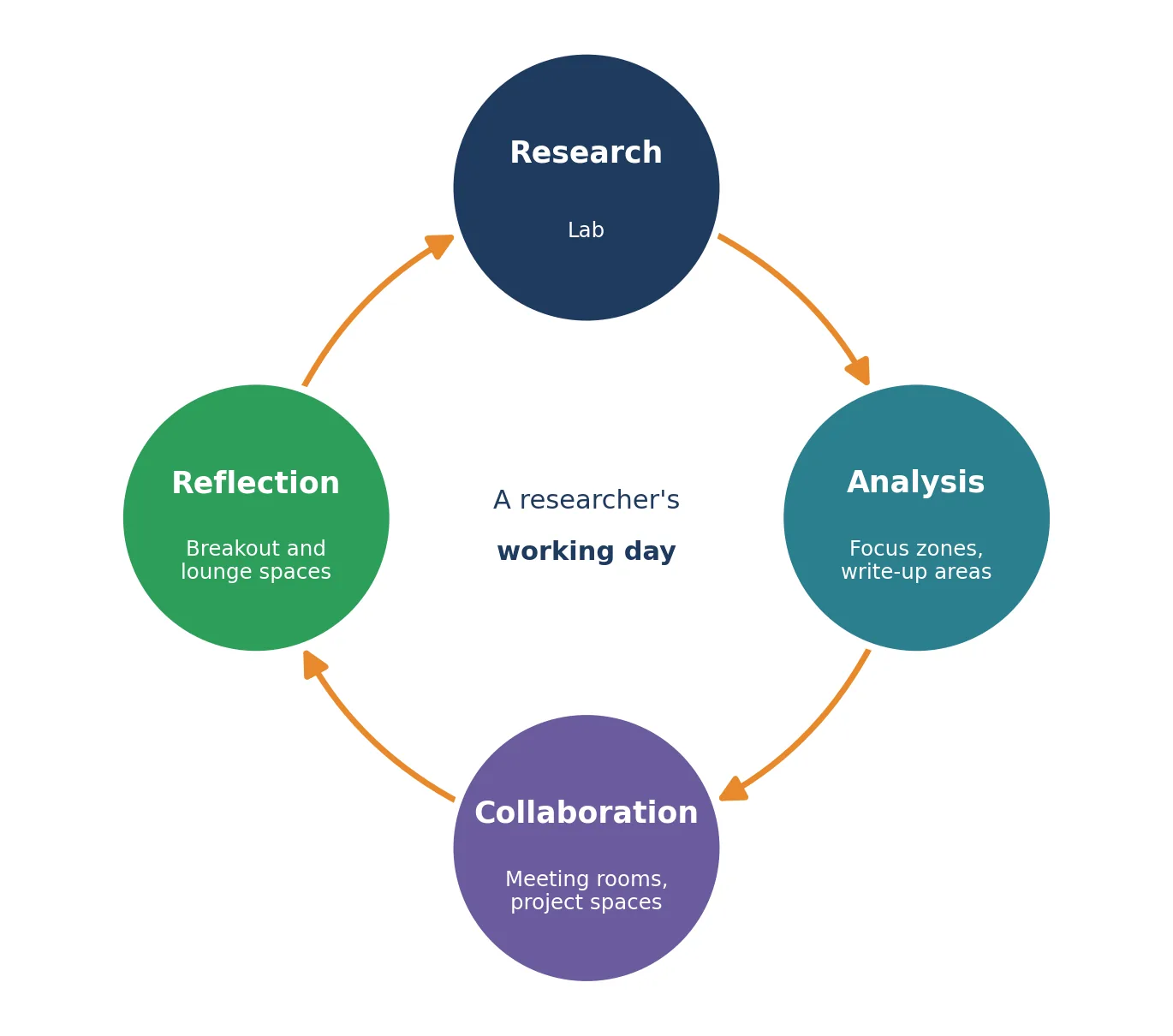
A workplace for researchers needs to support every part of that cycle, and make moving between them seamless.
Sound familiar?
- Researchers write up results at the lab bench, or at a crowded desk far from the lab.
- The only meeting room is always booked.
- Noise from discussions makes it hard to concentrate on analysis.
People take breaks inside the lab because there is nowhere else to go.
How we design workspaces for researchers
At Arena Consultants, we design the spaces around the lab with the same care as the lab itself. Here is how:
1. Focus zones for analysis and documentation
Data analysis, coding and documentation need concentration. We create quiet focus zones and write-up areas close to the labs, so researchers can move quickly between bench and screen, while keeping these spaces outside lab hazard areas.
2. Acoustic strategies for quiet and collaboration
Quiet work and lively discussion need different acoustic conditions. Using sound-absorbing finishes, careful zoning and enclosed rooms where needed, we separate focus areas from collaborative ones so each can work as intended.
3. Visual connectivity without compromising safety
Being able to see into the lab from a write-up area or corridor helps researchers keep an eye on experiments and supports a sense of connection across teams. Glazed partitions and vision panels provide that visibility while keeping the lab's safety boundaries, containment and fire separation intact.
4. Breakout spaces for a mental reset
Researchers need places to step away, recharge and think. Breakout spaces placed close to the lab, but outside it, let people take a proper break without feeling disconnected from their work. Keeping these spaces outside the lab also matters for safety, since eating and drinking do not belong in laboratory areas.
5. Furniture and layouts matched to scientific tasks
Different tasks involve different postures and durations: hours of focused analysis at a screen, short standing discussions, long seated meetings. We align furniture, desk heights, seating and layouts with the way each task is actually performed.
Matching spaces to the way researchers work
| Space | Supports | Key design features |
|---|---|---|
| Focus zones and write-up areas | Analysis, coding, documentation | Quiet acoustics, ergonomic desks, close to labs but outside hazard areas |
| Meeting rooms | Planned discussions, reviews | Good acoustics, screens for sharing data, easy booking |
| Project and collaboration spaces | Team problem-solving, informal discussion | Writable walls, flexible furniture, visual links to the lab |
| Breakout and lounge spaces | Rest, reflection, social connection | Comfortable seating, daylight, refreshments, outside lab areas |
| Cubicles and workstations | Individual desk work | Ergonomic setup, storage, power and data |
Try this: Follow one researcher through a typical day and note every space they use, from bench to desk to meeting room to break area. Where do they struggle to find the right space? That is where your facility needs attention.
Ask this: Have we designed the spaces around our labs with the same intent as the labs themselves?
Spaces designed around research
Workplaces for researchers should support the versatility of their jobs. When the spaces around the lab are designed around how science is really done, they improve both the speed and the quality of research.