
Designing Labs for 24x7 Operations
By Arena Consultants · July 4, 2025 · 4 min read
Laboratories are functional 24x7. Scientists may go home in the evening, but their experiments do not. Through the night, samples are incubated, materials are tested and equipment keeps running.
During those hours, it is often a single lab technician who stays on site to monitor systems, flag anomalies and make sure nothing goes wrong.
Yet most labs are not designed for this reality. They are planned around peak daytime activity, and night shifts are treated as an exception rather than a condition to design for. That creates undue stress for the people on shift, and it increases risk during some of the most vulnerable hours of a lab's operation.
What a lab's day really looks like
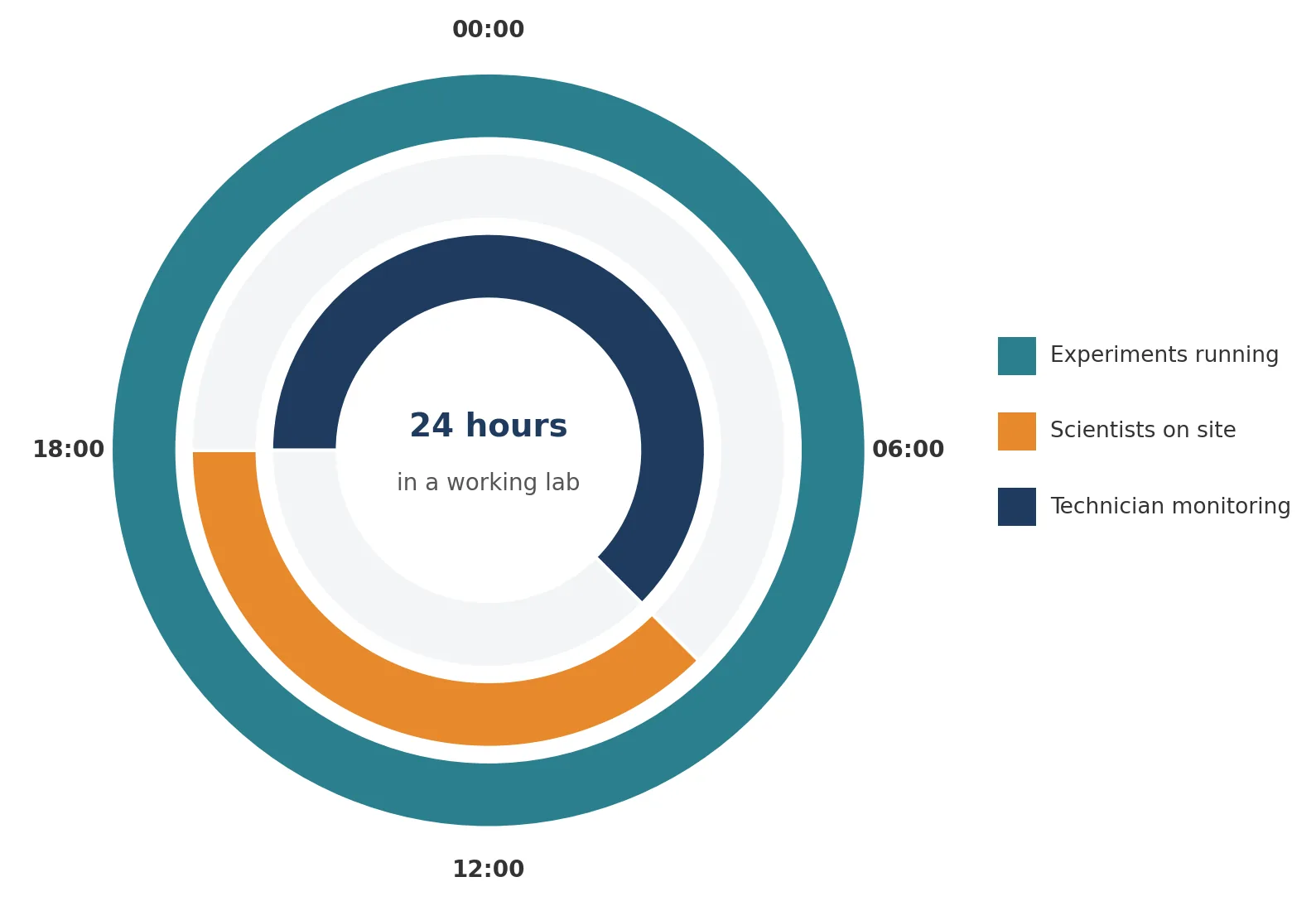
Night work brings its own challenges. Fewer people are on site, help is further away and fatigue sets in more easily. A layout that works well with a full team at noon can feel confusing, isolating and even unsafe at 3 a.m.
| Night-shift challenge | Why it matters | Design response |
|---|---|---|
| Fatigue | Alertness drops during the night | Focused task lighting and restorative pause spaces |
| Monitoring many systems alone | Problems can be missed or noticed late | Clear sightlines and well-placed monitoring interfaces |
| Moving through a quiet building | Empty spaces can feel unsafe and disorienting | Clear, uncluttered routes, signage and zoning |
| Working alone | Help is not immediately at hand | Emergency alarms, communication points and visibility from security |
| Long stretches on duty | No break means less vigilance | Rest spaces within sight of critical processes |
Sound familiar?
- Your night technician has to switch on every light in the lab to check one instrument.
- Critical equipment alarms can only be seen from inside one room.
- The only place to sit down is far from the equipment being monitored.
Night shifts were never mentioned in the design brief.
How we design labs for non-linear work hours
At Arena Consultants, we design labs for continuous operation, not just peak activity. That makes them more intuitive, predictable and supportive at any hour. Here is how:
1. Focused task lighting
Instead of lighting the whole lab at full brightness all night, we create well-lit work zones where technicians actually need them. Zoned lighting controls let people light the area they are working in without over-illuminating empty spaces, helping them stay alert without unnecessary glare or fatigue. It also saves energy.
2. Clear monitoring interfaces
Control panels, alarm displays and status screens are placed strategically, so one person can see the state of critical equipment at a glance. Clear sightlines into equipment rooms and simplified layouts reduce how far technicians need to walk, and how easily something can be missed. Where possible, remote monitoring brings alerts to wherever the technician is.
3. Safe and intuitive navigation
Uncluttered pathways, photoluminescent (glow) signage and clear zoning make the lab easy to understand even when it is quiet and dimly lit. A space that feels predictable also feels secure, which matters when only one or two people are in the building.
4. Restorative micro-spaces
Compact seating areas or pause zones, placed within sight of ongoing processes, let technicians take short breaks without losing touch with the equipment they are responsible for. Access to water and a small pantry nearby makes long shifts more manageable.
5. Support for working alone
Night technicians often work alone, so the design should make it easy to raise help quickly. Emergency alarms, communication points, visibility from security staff and access control all support lone workers, alongside the organisation's own lone-working procedures.
Try this: Walk through your lab after dark with the lights set as they would be on a night shift. Check whether you can see every critical alarm, find every exit easily and reach a place to sit within sight of the equipment. Anything that feels awkward to you will feel worse at 3 a.m.
Ask this: Who will be in our lab at night, what will they be responsible for, and has our design been tested against their shift?
From peak activity to continuous responsibility
A lab is never really closed. Designing for that reality means shifting from designing for peak activity to designing for continuous responsibility, so the people who keep experiments running overnight can do so safely, calmly and confidently.