
Why Do Lab Users Need Vibrant Laboratory Spaces?
By Arena Consultants · January 12, 2026 · 7 min read
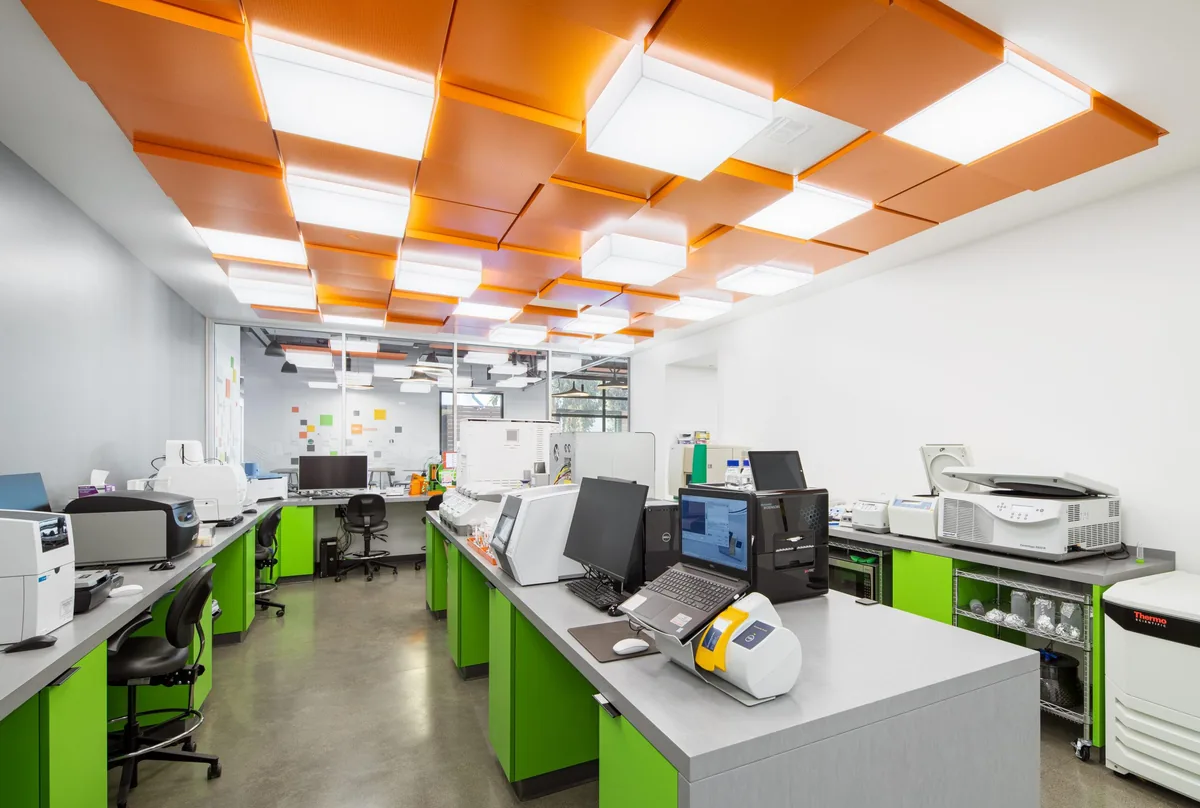
Ask anyone to describe a laboratory and you will hear the same words: precision, safety, equipment, compliance. All true. But there is something those words leave out, and that is the experience of the people inside.
Researchers, technicians and scientists spend long hours in the lab. They run detailed experiments, analyse data, troubleshoot results that refuse to behave and make decisions that need sustained attention. That is everyday life for a lab user.
So when a lab is designed purely around technical requirements, it may work perfectly on paper and still feel flat, sterile and draining in practice. Over a long day, that matters.
1. A lab is more than a functional space
Lab design has always, and rightly, put function first: safety, workflow, services, storage, fume hood placement, air changes. Once those are solved, the visual side of the space often gets whatever is left. Usually that means white walls, grey benches and not much else.
The US National Institutes of Health (NIH) addresses this directly in its technical guidance on colour in laboratory design. It points out that researchers often work long hours in labs, that it is in everyone's interest for them to stay alert, precise and healthy, and that traditional labs have tended to be bland, sterile and neutral. Its conclusion: designers can help by creating labs that are aesthetically pleasing as well as functional.
When a lab gets this right, its users find it easier to:
- Stay alert through long experimental runs and repetitive tasks.
- Think creatively when a problem needs a fresh angle.
- Work efficiently because the space is legible, comfortable and pleasant to return to.
Sound familiar?
- Your team spends breaks anywhere except the lab.
- New hires describe the space as "clinical" or "like a hospital."
- Nobody can tell one lab module from another without reading the door sign.
If two or more of these ring true, the space may be working against your people rather than for them.
2. Colour is the simplest lever you can pull
Of all the ways to bring life into a lab, colour is the most accessible. It needs no structural change and no new equipment, yet it changes how a space feels the moment you walk in.
Research on colour psychology suggests that warm colours and cool colours tend to work in different ways. Warm, longer-wavelength colours such as yellow and orange are associated with energy and stimulation. Cool, shorter-wavelength colours such as blue and green are associated with calm and steadier concentration.
| Colour family | How it tends to feel | Where it fits in a lab |
|---|---|---|
| Warm (yellow, orange) | Energising, optimistic, social | Breakout zones, collaboration areas, entrances, feature walls |
| Cool (blue, green) | Calm, steady, focused | Analytical labs, instrument rooms, write-up desks, long-concentration work |
| Neutrals (white, light grey, muted tones) | Clean, balanced, restful for the eye | Base walls, ceilings, work surfaces and anywhere colour judgement matters |
The NIH guidance adds an important caveat: how a person responds to colour depends on the individual and on how and where the colour is used. That is why colour decisions should come out of conversation with the people who will use the space, not from a generic palette.
3. Get the balance between accent and neutral right
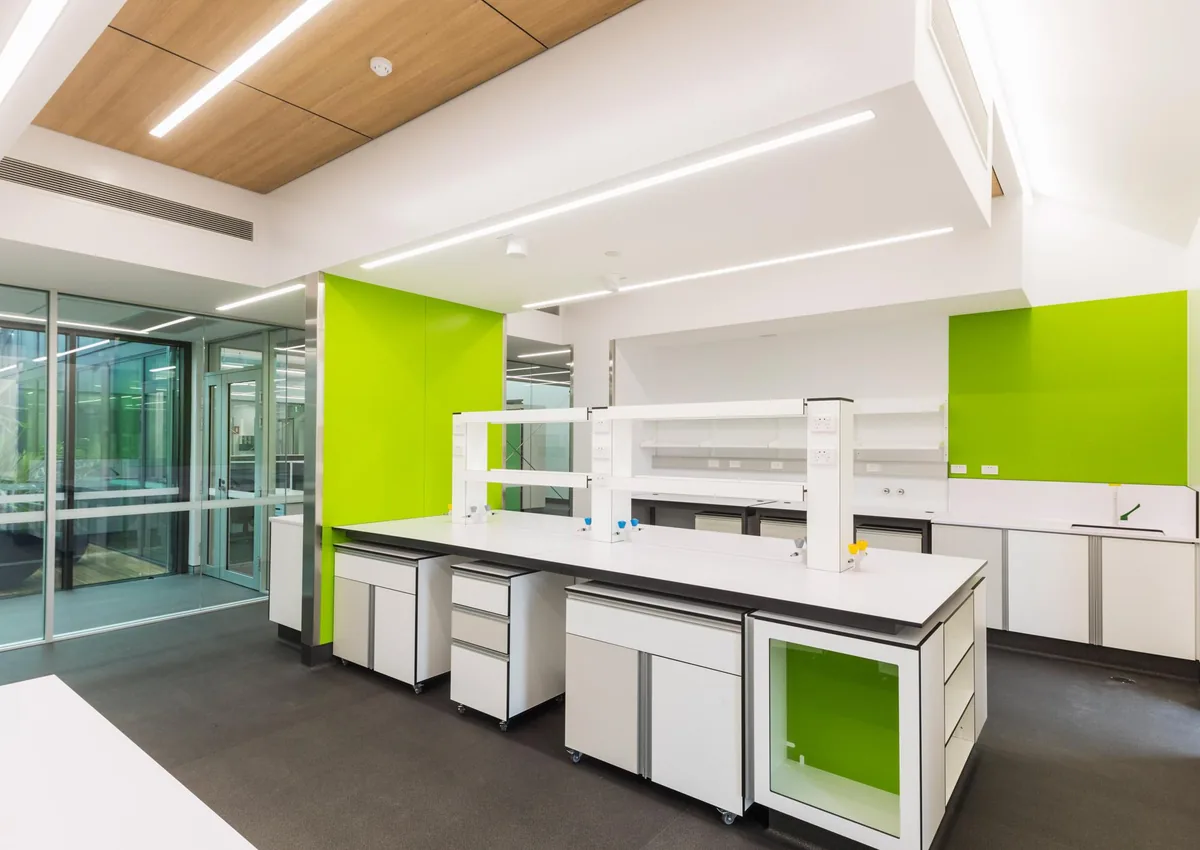
This is where most colour schemes succeed or fail. A completely neutral lab can feel under-stimulating. A lab drenched in strong colour can feel overwhelming and distracting. The NIH guidance makes the same point and recommends using colour judiciously.
The answer is the proportion between base colours and accent colours. A simple starting point many designers use is a 60-30-10 split:
| Share of the space | Role | Typical lab application |
|---|---|---|
| About 60% | Base / neutral | Walls, ceiling, work surfaces |
| About 30% | Secondary | Furniture, cabinet fronts, flooring zones |
| About 10% | Accent | Feature walls, doors, stools, graphics, wayfinding |
Think of it this way. A bright green cabinet against a neutral background is an intentional design feature. The same green on every surface is a very different room. Treat 60-30-10 as a guide, not a rule: a busy wet lab full of equipment may want an even calmer base, while a breakout area can take a bolder accent.
4. Zone your colour by the work each space supports
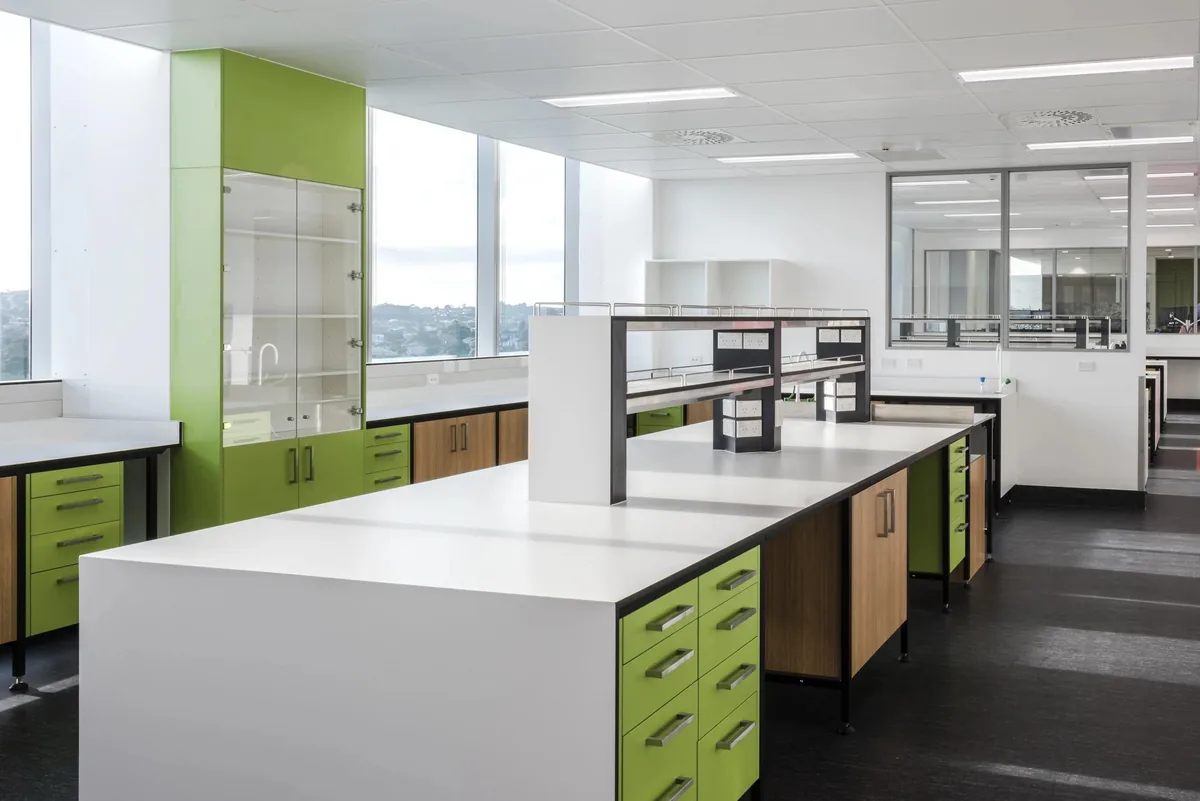
Not every part of a lab needs to feel the same. Once you know what happens where, colour can be planned zone by zone:
| Zone | What the space needs | Colour approach |
|---|---|---|
| Research and bench areas | Concentration, visual clarity | Calm palette, neutral backgrounds, colour kept away from work surfaces |
| Collaboration areas | Discussion, interaction | More expressive accents to mark the space as different |
| Breakout areas | Recovery, a mental reset | Brighter or warmer tones to create a clear break from intensive work |
| Circulation and wayfinding | Easy navigation | Colour-coded zones, floor bands and doors to help people find their way |
This shifts the question from "What colour looks good?" to "What should this space support?" That is a far more useful conversation to have with your designer.
5. Know where colour should not go
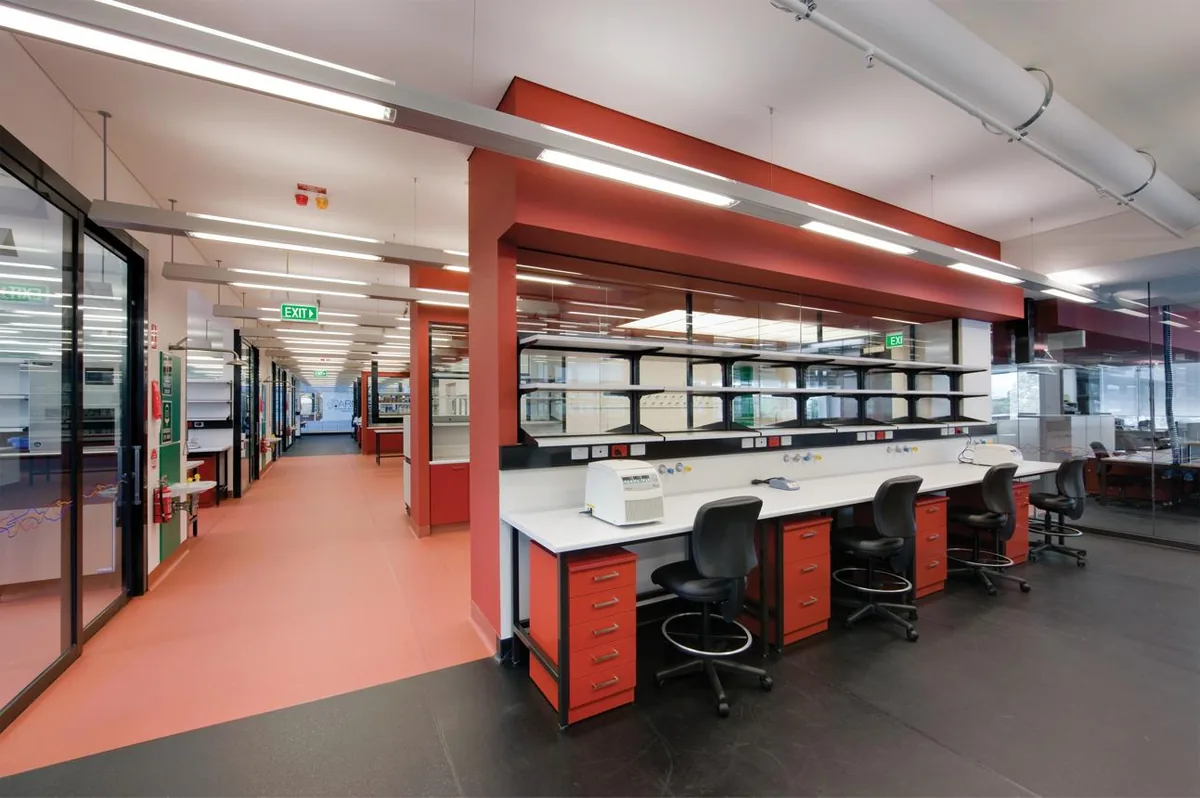
In a laboratory, colour has jobs to do beyond mood. A vibrant lab still has to respect them:
- Keep work surfaces neutral wherever scientists judge colour by eye, such as titrations, colorimetric tests or cosmetic shade matching. A bright surface or wall right behind the bench can distort what they see.
- Protect safety colours. Red, yellow, green and blue already carry meaning on safety signage, emergency equipment and colour-coded service lines. Decorative accents should never compete with or blur these signals.
- Plan colour and lighting together. Even the best palette looks dull under poor light, and the wrong light can change how a colour reads entirely.
Try this: Walk through your current lab and note every place a colour is already doing a safety or functional job. Those are your "no-touch" zones. Everything else is an opportunity.
6. Brief your designer on feel, not just function
If you are setting up or upgrading a lab, your requirement sheet will naturally be full of technical needs: equipment lists, services, safety class, occupancy. All essential. But if the brief stops there, the space will be designed to function and nothing more.
Before your next design meeting, add these questions to the conversation:
Ask this: how should the space feel? Calm and focused? Energetic and collaborative? A mix, zone by zone? Agreeing on a feeling gives your designer a clear target beyond the technical checklist.
Ask this: what is the nature of the work performed here? Long solo analytical runs need a different atmosphere from fast, team-based formulation work. Where do users need maximum concentration, and where will collaboration happen?
Ask this: how can the space feel more inspiring? Think about natural light, materials, graphics that tell the story of your science, and places for people to pause and think. Inspiration rarely comes from the bench alone.
These are small questions, but they make a big difference to how people end up using the space every day.
Designing labs people want to work in
A laboratory has to perform first. It must support safety, workflow, precision, equipment and maintenance. That is the baseline, and it is never up for negotiation.
But performing well and feeling good are not opposites. Thoughtful use of colour, materials, lighting, furniture and spatial planning can create labs that are fully functional and genuinely supportive for the people inside them. The aim is not simply a colourful lab. It is a lab that works better for its users.
So the next time you discuss your requirements with a designer, ask one more question: how should this space feel for the people working in it? The answer could shape far more than the colour of the walls.