
How Technology Is Enabling Efficiency in Day-to-Day Lab Operations
By Arena Consultants · December 24, 2025 · 4 min read
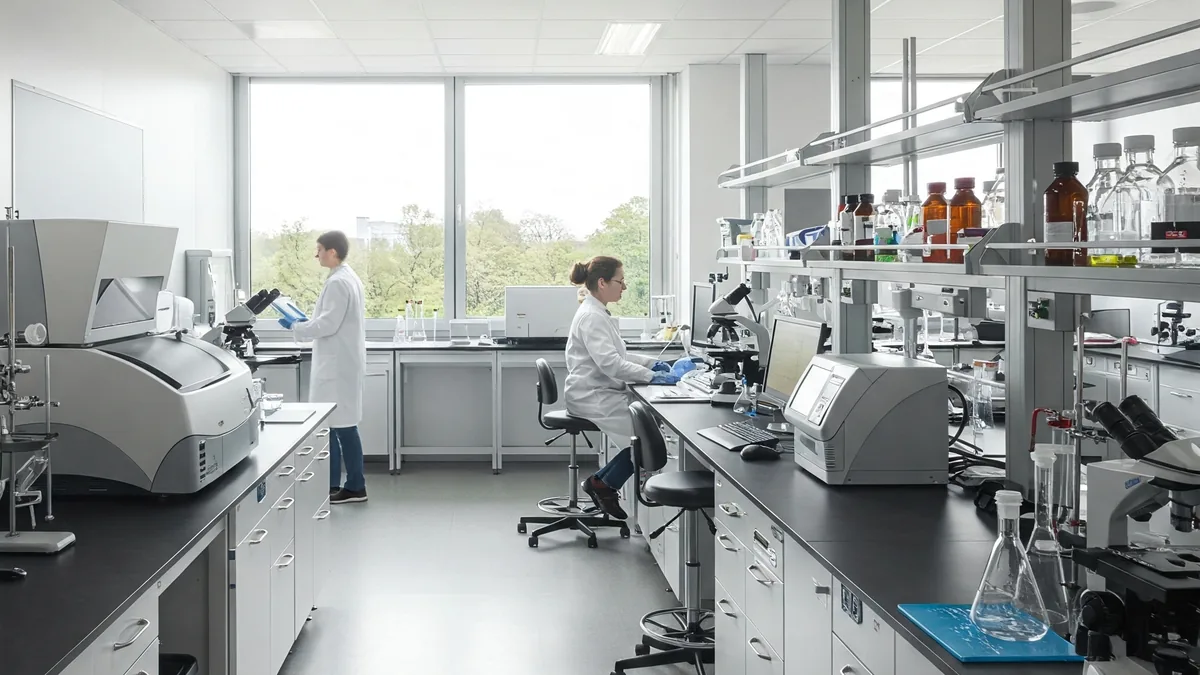
Not long ago, much of a lab technician's day was spent on repetitive, physically demanding and often stressful manual work: pipetting sample after sample, logging readings by hand, walking back and forth to fetch supplies and checking equipment in person.
Today, more and more of that work is supported by automated systems. Robotic arms handle repetitive tasks, biosafety cabinets have touchless controls and many instruments sync with a phone or tablet. Labs are becoming sleeker, safer and smarter.
These changes do not only affect the equipment. They are redefining the physical infrastructure and demands of the lab itself, and how it feels to work there every day.
Where labs are today
Five changes are already making daily lab operations more efficient:
1. Ergonomic workstations
Adjustable benches, supportive seating and well-placed equipment help researchers stay comfortable through long work sessions. Less strain means fewer breaks for discomfort and fewer errors caused by fatigue.
2. Controlled environments
Modern environmental controls keep temperature and humidity steady, supporting both thermal comfort for people and stable conditions for sensitive experiments and instruments. Monitored environments are also more resilient: problems are spotted before they disrupt work.
3. Touchless technology
Touchless controls on biosafety cabinets, doors, taps and equipment reduce the number of surfaces people need to touch. That improves hygiene and lowers contamination risk, and it saves small movements and effort that add up over hundreds of daily tasks.
4. Modular layouts
Mobile benches, modular furniture and plug-and-play services let teams reconfigure their lab with minimal effort when projects, equipment or team sizes change. What once needed a contractor can now often be done in a day.
5. Digital and smart storage
Smart storage systems track inventory, flag low stock and show exactly where items are kept. Placed close to where they are needed, they minimise unnecessary movement and the time spent searching for supplies.
| Technology | Daily benefit | What the lab design must provide |
|---|---|---|
| Ergonomic workstations | Comfort and fewer errors in long sessions | Right bench heights, adjustable options, good reach zones |
| Controlled environments | Comfort and stable experimental conditions | Well-zoned HVAC, sensors and controls integrated with the building |
| Touchless controls | Better hygiene, less effort | Power and data at the right points, compatible fixtures |
| Modular layouts | Fast reconfiguration | Overhead or flexible services, structural grid that allows change |
| Smart storage | Less walking and searching | Storage at the point of use, network connectivity |
And this is just the beginning
As technology advances, labs can evolve into adaptive ecosystems: spaces that respond to both scientific needs and human behaviour. In the near future, we can expect:
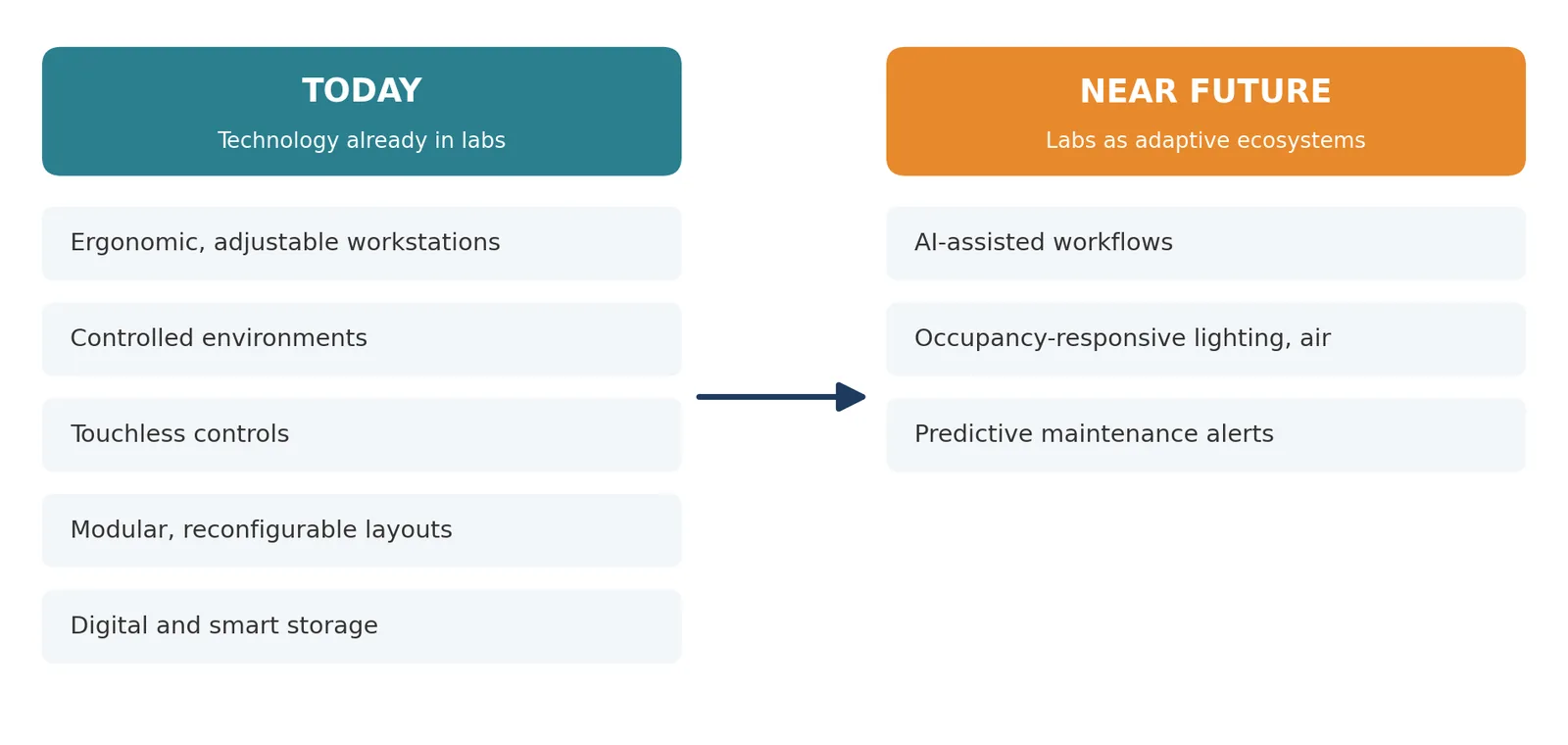
- AI-assisted workflows that learn daily patterns and optimise how equipment is booked and used, reducing queues and idle time.
- Occupancy sensors that adjust lighting and ventilation in real time. Since labs typically use 5 to 10 times more energy per square foot than offices, according to the US National Renewable Energy Laboratory, matching ventilation to real occupancy, within safe limits, can make a big difference to running costs.
- Predictive maintenance alerts that flag when equipment or building systems are likely to need attention, so problems are fixed before they interrupt research.
Designing technology into the DNA of the lab
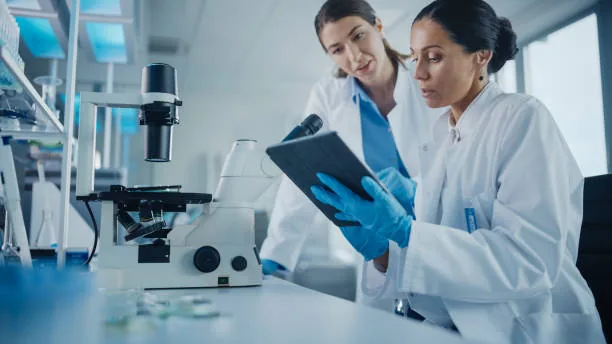
Technology only delivers these benefits when the lab is designed to support it. Touchless controls need power and data in the right places. Smart storage needs to sit where people actually work. Modular layouts need services that can move. Occupancy-based ventilation must be designed so it never compromises safety.
That is why, as lab architects, we are excited about integrating technology into the physical and functional DNA of the space, rather than adding it on after the lab is built.
Sound familiar?
- Your team still logs equipment readings by hand.
- People spend part of every day searching for supplies.
- Rearranging the lab means waiting for a contractor.
Lights and ventilation run at full power in empty rooms.
Try this: Ask your team to list the three most repetitive or tiring tasks in their day. For each one, ask whether a technology, or a better-designed space, could make it easier. Those answers are a strong starting point for your next lab upgrade.
Smarter labs, better days
Technology is turning labs from places of repetitive manual work into smarter, safer environments that support the people inside them. The most efficient labs of the future will be those where technology and design work together from the start.