
Sustainable Lab Design: Balancing Safety, Science and Sustainability
By Arena Consultants · October 10, 2026 · 4 min read
Laboratories are where new medicines, materials and technologies are born. But behind every scientific breakthrough is a building working extremely hard: moving vast volumes of air, running equipment around the clock and consuming far more resources than almost any other building type.
That creates a unique design challenge. How do we make labs more sustainable without compromising the safety of the people inside them or the performance of the science?
Why labs have such a large footprint
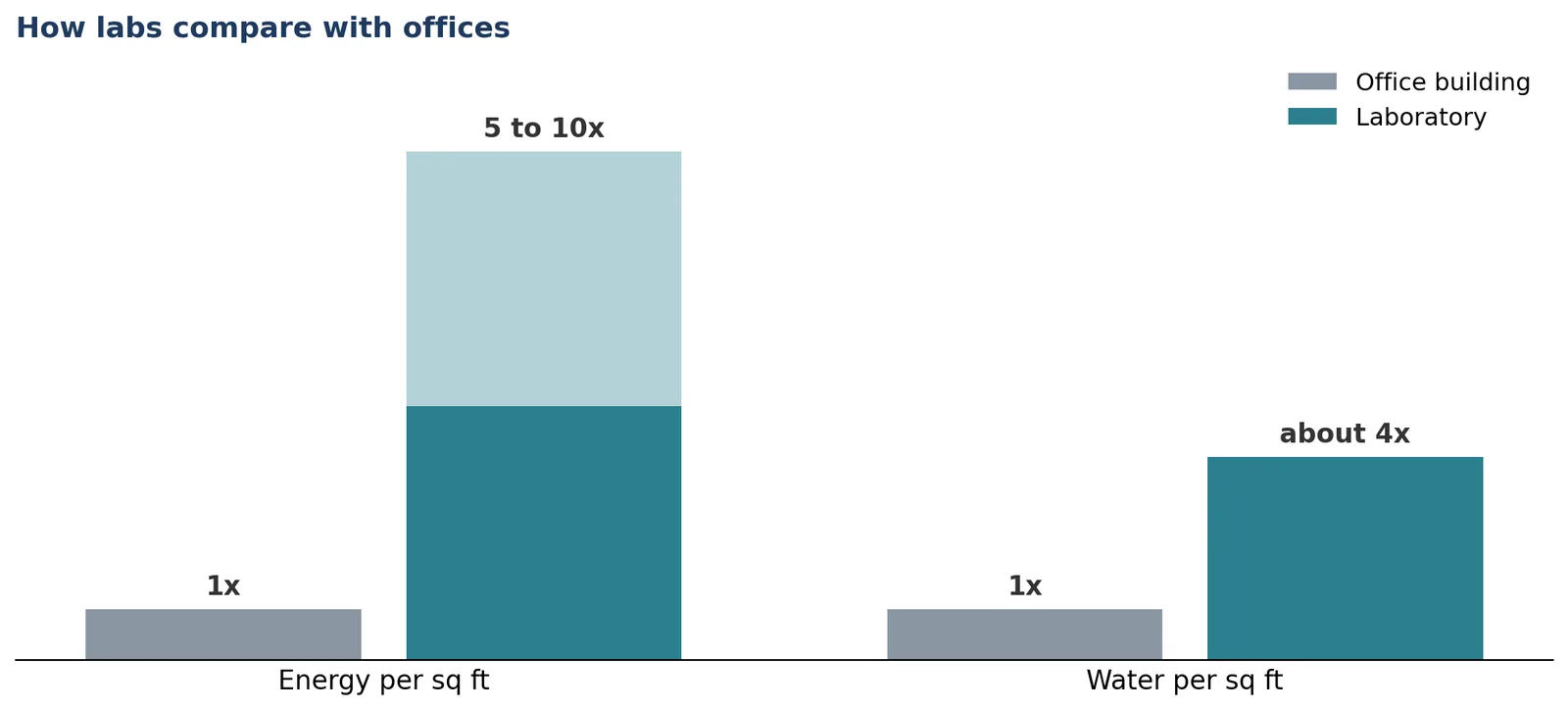
The numbers are striking. According to the US National Renewable Energy Laboratory, labs typically use 5 to 10 times more energy per square foot than office buildings. My Green Lab, a non-profit focused on lab sustainability, estimates that labs also use about 4 times more water than equivalent office spaces.
The four big sustainability challenges in lab design
1. High energy use
Labs rely on powerful HVAC systems and equipment that often run around the clock. Most of the energy goes into ventilation: lab air usually cannot be recirculated, so it is conditioned, used once and exhausted, then replaced with fresh air that has to be conditioned all over again. Freezers, incubators and instruments add continuous loads on top.
Design response: Right-size ventilation to the real hazard rather than the worst case, use variable air volume fume hoods, reduce air changes safely when spaces are unoccupied, recover heat from exhaust air where it is safe to do so, and group heat-generating equipment so it can be cooled efficiently.
2. Water demand
Processes such as sterilisation and cooling need substantial amounts of water. According to My Green Lab, a single autoclave cycle can use as much as 340 litres, and making purified (DI) water takes around three litres of tap water for every litre produced. Older single-pass cooling systems, which run water through equipment once and send it straight to drain, are among the biggest sources of waste.
Design response: Replace single-pass cooling with closed-loop systems, specify water-efficient autoclaves and glassware washers, size purified water systems to real demand, and consider reusing reject water or air-conditioning condensate for non-critical uses.
3. Material sensitivity
Labs need materials that resist chemicals, heat and frequent cleaning, and many substances used during construction and operation need special handling. That narrows the choice of finishes and makes waste harder to manage.
Design response: Choose durable, chemical-resistant materials that last longer and need replacing less often, prefer low-emission finishes, use modular furniture that can be reconfigured instead of replaced, and plan dedicated, well-designed spaces for segregating and storing waste streams.
4. Stringent codes
Labs are governed by strict safety standards and codes. Rightly so: they protect people from real hazards. But they do not always leave much room for experimenting with new approaches, and sustainability measures can never come at the expense of safety.
Design response: Bring safety specialists and engineers into sustainability decisions early, so every energy-saving measure is designed to meet code from the start. Green building rating systems such as LEED, IGBC and GRIHA provide recognised frameworks for proving that a lab is both compliant and efficient.
Striking the balance: it starts at the design table
So how do we balance safety, science and sustainability? In our experience, it starts at the design table, with architects, engineers and lab planners all thinking green from Day 1.
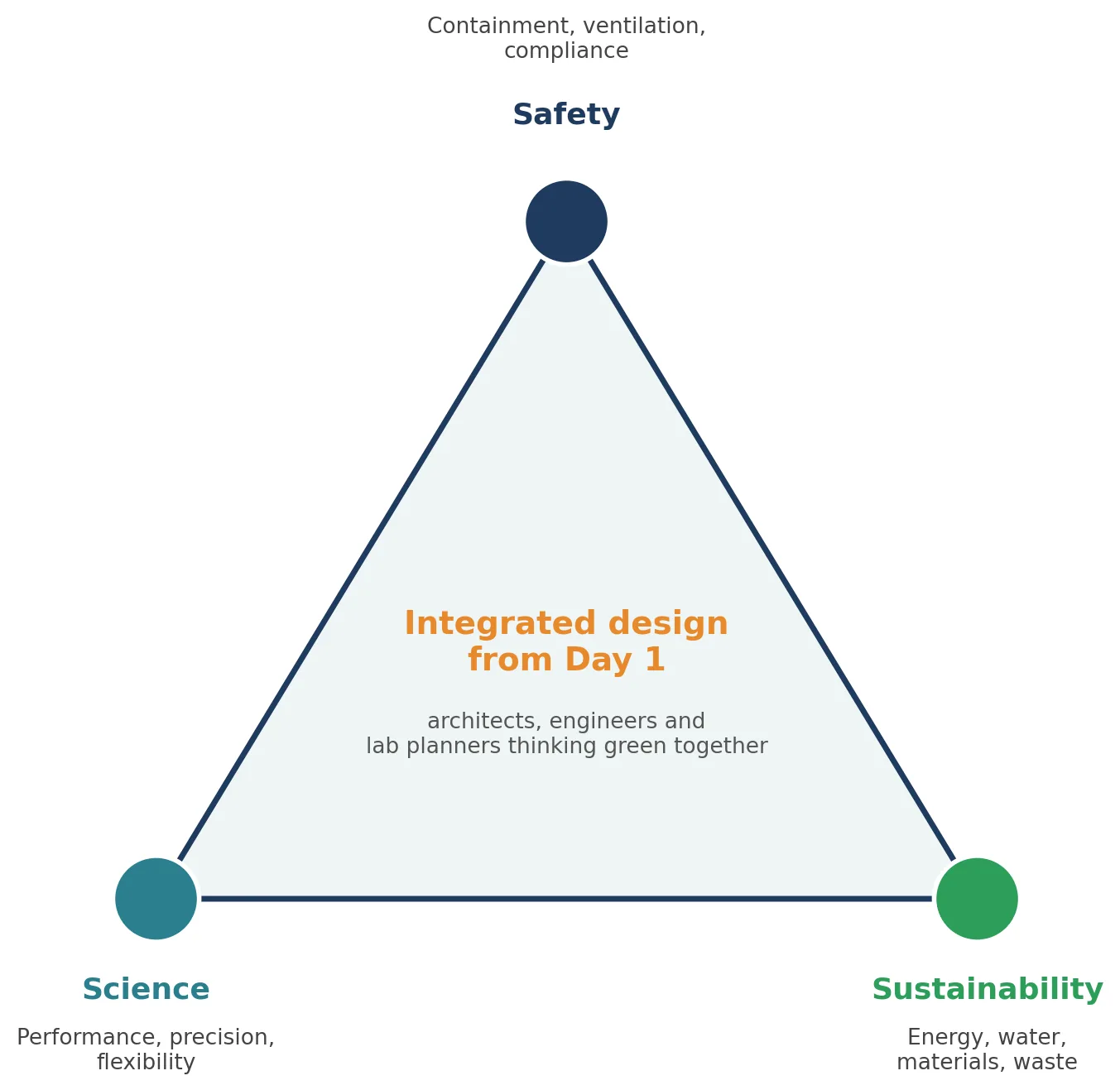
Sustainability added at the end of a project tends to be expensive and limited: a few efficient fittings on a building whose biggest decisions are already fixed. Sustainability designed in from the start shapes those big decisions: how much space needs high air change rates, where equipment sits, how services run and how flexible the lab will be over its life.
| Sustainability added late | Sustainability from Day 1 | |
|---|---|---|
| Ventilation | Fixed high airflow everywhere | Airflow matched to real hazards and occupancy |
| Water | Efficient taps on a wasteful system | Closed-loop cooling and right-sized purification |
| Materials | Chosen for first cost | Chosen for durability and life-cycle impact |
| Flexibility | Renovation means demolition | Modular layouts adapt without waste |
| Certification | Difficult and costly to retrofit | Planned into the design from the start |
That is why we see our role as bridging the sustainability gap, embedding sustainability into the DNA of every project rather than treating it as an add-on.
Sound familiar?
- Your lab's energy bill is one of the biggest running costs on site.
- Fume hoods run at full airflow all night.
- Cooling water flows straight to the drain.
Sustainability was discussed only after the design was finished.
Try this: Walk through your lab at night or on a weekend. Note which equipment, lights and fume hoods are running in empty rooms. That list is the start of your sustainability brief.
Ask this: At what stage of our lab project will sustainability targets be set, and who is responsible for meeting them?
Sustainable labs are better labs
Making labs more sustainable is not about choosing between the planet and the science. Done well, sustainable design lowers running costs, creates healthier spaces and produces labs that adapt more easily as research changes, all while keeping safety non-negotiable.
The labs of the future will be judged not only by the breakthroughs they enable, but by how responsibly they enable them.