
How Do Regulatory Standards Make Laboratory Designs More Efficient?
By Arena Consultants · April 24, 2026 · 6 min read
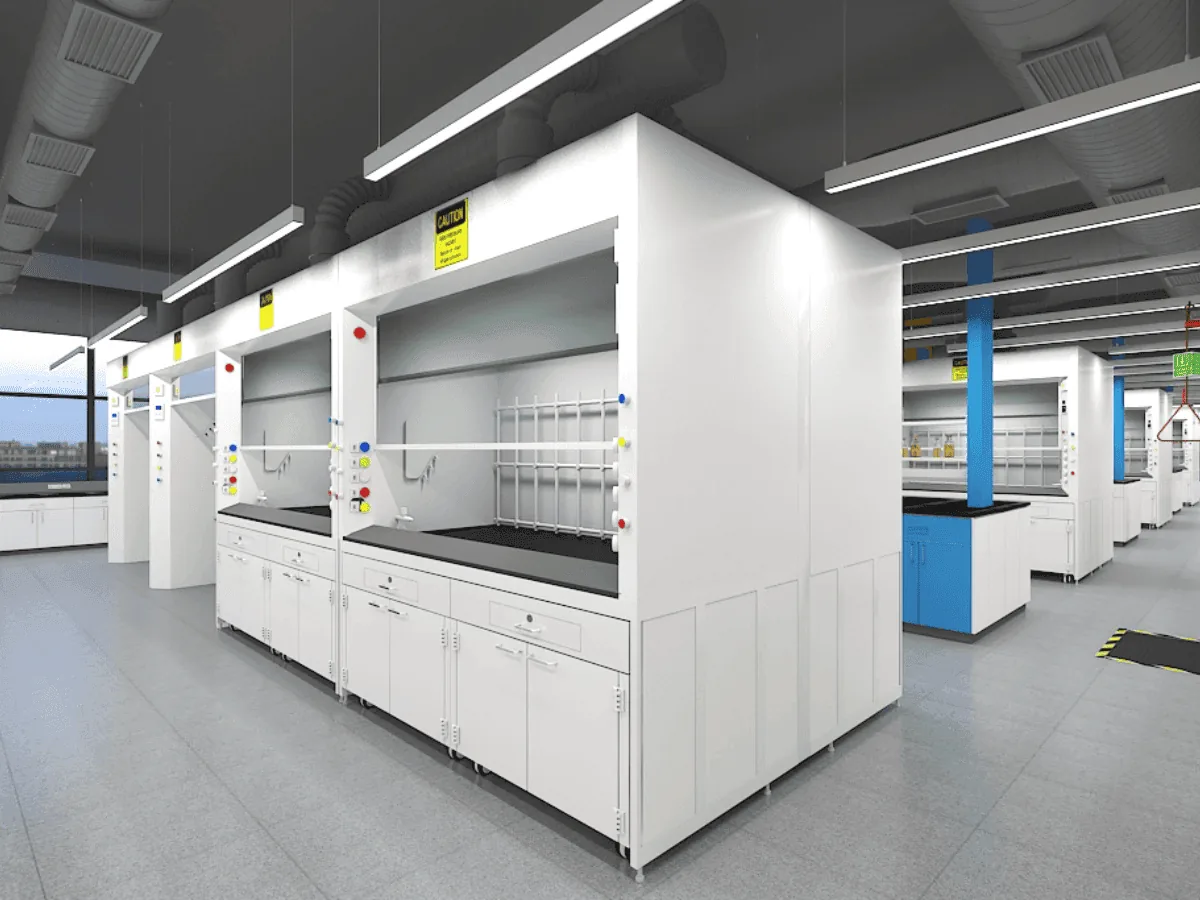
Designing a laboratory is a highly function-driven job. It demands precision, safety and compliance with a wide range of standards, covering everything from fire safety and airflow to chemical storage, energy use and quality systems.
It is easy to see these standards as a checklist to clear before approval. But when they are built into a design from the first sketch, they do much more than keep a lab legal. They reduce risk, streamline approvals and accreditation, cut running costs and create a clear framework for good decisions. In short, they make labs more efficient.
Which standards must lab designers comply with?
Lab design standards differ from country to country because of differences in climate, construction practice, seismic conditions and legal systems. At Arena Consultants, we design to Indian, US and European standards on a project-by-project basis, so our labs meet both local requirements and global benchmarks. This matters especially for multinational clients, whose labs often have to satisfy both Indian codes and their headquarters' standards.
The standards that apply to a lab build on each other, from the general requirements every building must meet to the specific rules for particular sectors and equipment:
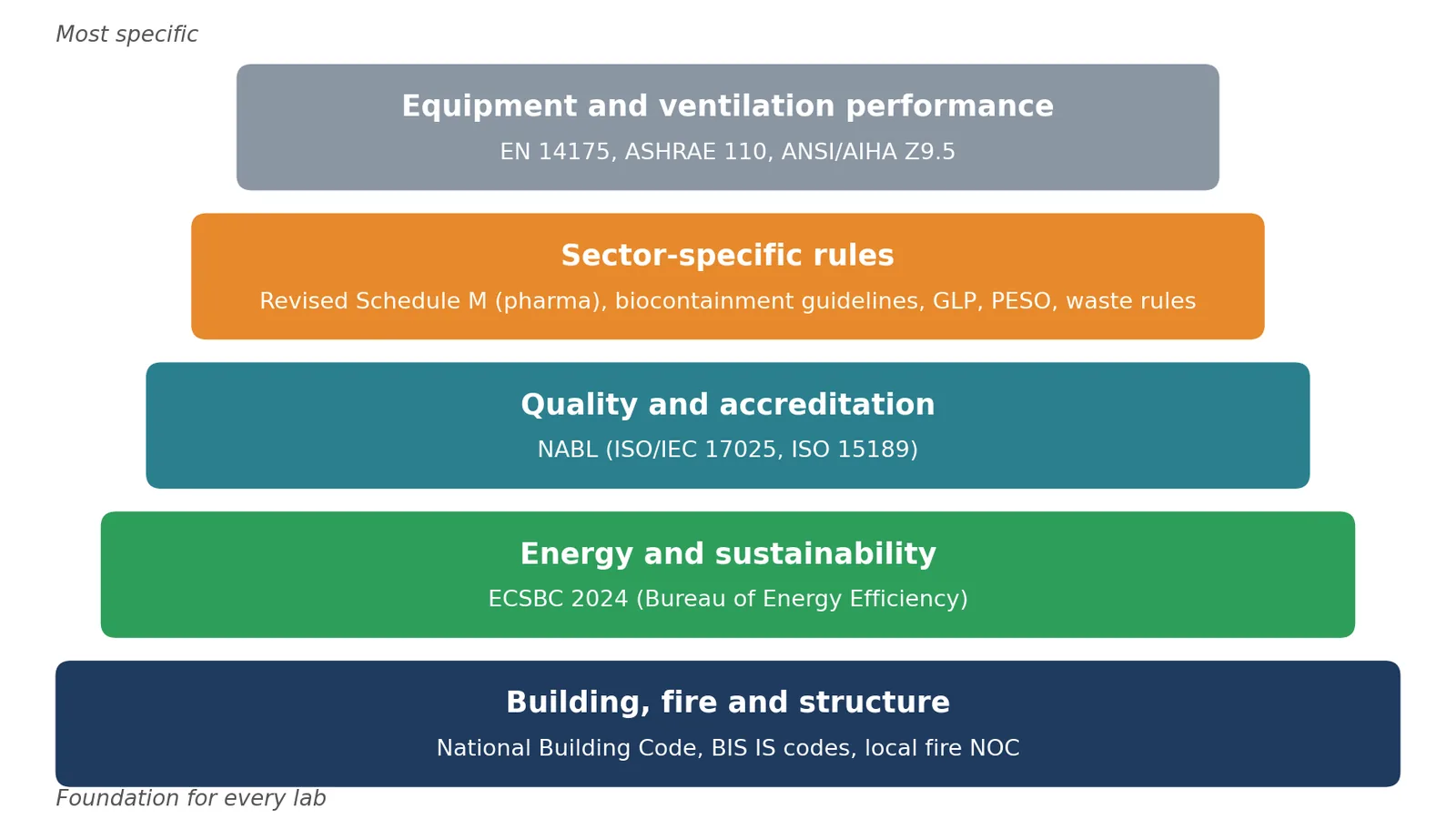
Key Indian standards for lab design
1. National Building Code of India (NBC)
The NBC, published by the Bureau of Indian Standards, sets the ground rules for building design and construction across India. It covers structural safety (including design for earthquakes), fire and life safety, building services such as lighting, ventilation and air conditioning, plumbing, and accessibility.
What it means for lab design: NBC shapes the lab building itself: escape routes, fire separation, structural design, service provisions and accessible access. Designing to it from the start avoids layouts that later fail fire or approval reviews.
2. Bureau of Indian Standards (BIS) codes
Alongside the NBC, BIS publishes Indian Standard (IS) codes that set technical requirements for specific aspects of construction, such as earthquake-resistant design (IS 1893) and electrical wiring installations (IS 732), as well as material and product specifications.
What it means for lab design: IS codes govern the details: structure, electrical systems and materials. Following them keeps the lab relevant to Indian construction practice and simplifies approvals.
3. National Accreditation Board for Testing and Calibration Laboratories (NABL)
NABL accredits testing and calibration laboratories in India to ISO/IEC 17025, and medical laboratories to ISO 15189. These standards focus on quality management and technical competence. Among their requirements, labs must have facilities and environmental conditions that are suitable for their work and do not compromise the validity of results.
What it means for lab design: If a lab plans to seek NABL accreditation, the design has to support it: controlled environments where results depend on temperature, humidity or cleanliness, separation of incompatible activities, protection from vibration where instruments need it, and secure areas for samples and records. Designing for accreditation from the start avoids costly modifications before an audit.
4. Energy Conservation and Sustainable Building Code (ECSBC) 2024
Issued by the Bureau of Energy Efficiency (BEE), the ECSBC 2024 builds on and replaces the earlier Energy Conservation Building Code (ECBC 2017). It sets energy efficiency and sustainability requirements for commercial buildings above specified load thresholds, including provisions for the building envelope, lighting, HVAC, electrical systems and renewable energy. It has three tiers: ECSBC Compliant, ECSBC Plus and Super ECSBC. Its application depends on adoption by each state.
What it means for lab design: Labs are high-energy buildings, driven by ventilation, fume hoods and equipment running around the clock. Designing to ECSBC lowers running costs for the life of the building. Under the earlier code, BEE estimated that compliant buildings could save around 25% of energy compared with conventional buildings, with higher tiers saving more.
Sector-specific rules
Depending on the work a lab does, several more regulations may apply:
| Regulation | Applies to | Design impact |
|---|---|---|
| Good Laboratory Practice (GLP), monitored in India by the National GLP Compliance Monitoring Authority | Labs running non-clinical safety studies for regulatory submission | Separation of activities, secure test item storage, controlled archives |
| Revised Schedule M (Good Manufacturing Practices) | Pharmaceutical manufacturers, including their quality control labs | Segregated QC areas, suitable environmental controls, materials flow |
| Biocontainment guidelines (Department of Biotechnology) | Labs working with biological agents (BSL labs) | Containment level, airflow direction, access control, finishes |
| Petroleum and Explosives Safety Organisation (PESO) licensing | Storage of petroleum products and certain solvents above specified quantities | Solvent store design, location and separation |
| Hazardous waste and biomedical waste rules | Labs generating chemical or biological waste | Waste segregation, storage and collection spaces |
| Local fire NOC | Most lab buildings | Fire detection, suppression, escape and compartmentation |
International standards we also refer to
To meet global benchmarks of safety and performance, we also draw on international standards where they add value or where clients require them:
| Standard | What it covers |
|---|---|
| NFPA 45 | Fire protection for laboratories using chemicals (US) |
| NFPA 400 | Storage and handling of hazardous materials (US) |
| EN 14175 | Fume cupboard design and performance (Europe) |
| ASHRAE 110 | Testing the performance of laboratory fume hoods (US) |
| ANSI/AIHA Z9.5 | Laboratory ventilation (US) |
| ASHRAE and ISHRAE guidance | HVAC design, with ISHRAE providing guidance suited to Indian conditions |
| OSHA | Occupational safety and health requirements for workplaces, including labs (US) |
How standards make lab design more efficient
Compliance is often treated as a cost. In practice, designing to standards from Day 1 saves time and money in several ways:
- Fewer redesigns. A layout that already meets fire, structural and accreditation requirements does not need reworking when reviewers or auditors check it.
- Faster approvals and accreditation. Complete, code-compliant drawings move through fire NOC, statutory approvals and NABL or GLP audits more smoothly.
- Lower running costs. Energy codes push designs towards efficient ventilation, lighting and equipment, cutting bills for decades.
- Safer, smoother operations. Standards encode decades of lessons about safe workflows, storage and ventilation, so the lab works well from the day it opens.
- Clearer decisions. Standards give the whole project team a shared framework, which speeds up decisions and reduces debate.
Sound familiar?
- A fire review forced late changes to the layout.
- An accreditation audit flagged problems with the lab environment after it was built.
- Energy bills were higher than anyone expected.
Each of these usually traces back to standards treated as an afterthought.
Ask this: Which standards, accreditations and certifications will our lab need in the next five years, and has our designer planned for all of them from the start?
Compliance as a design tool
Laboratory design needs the right balance of creative thinking and technical know-how. Regulatory standards provide the technical backbone: when they are understood and built in from the start, they become a tool for efficiency rather than a barrier to it.
The result is a lab that is safe from the day it opens, ready for audits and accreditation, and efficient to run for years to come.